Dominica offers a unique landscape distinct from any other in the Caribbean. Unlike its flatter neighbours, the Nature Island is defined by its lush mountains, dense rainforests, and an abundance of rivers and waterfalls. While many tourists opt for organised tours, there is no substitute for the freedom of exploring Dominica’s natural wonders by car.
Having your own vehicle allows you to bypass the constraints of minibuses and explore the hidden corners of the island on your own schedule. While the island is small, its geography is incredibly complex. Relying on public transport or taxis to reach remote trailheads like the Boiling Lake or secluded spots like the Kalinago Territory can be both expensive and restrictive.
The decision to rent a car is often the difference between a standard vacation and a true adventure. Driving in Dominica can be challenging, with steep inclines and sharp hairpin turns, but it rewards adventurers with breathtaking views of the Caribbean Sea and the Atlantic Ocean.
Before you pick up your car at Douglas-Charles Airport or in Roseau, it is essential to understand the traffic rules, unique customs, and physical demands of the Dominican road network. This guide provides you with ten practical tips to help you navigate this beautiful island like a local.
Every visitor is legally required to obtain a temporary Dominican driver’s permit. This currently costs approximately 30 East Caribbean Dollars and is valid for one month. Most car rental agencies will facilitate this process for you at the time of pick-up, issuing the permit on the spot upon presentation of your valid home licence.
Ensure this is sorted before you drive off the lot, because your driving licence is not sufficient on its own to drive on the island. Failing to have this permit can lead to significant complications with your insurance coverage in the event of an accident or may result in a fine if you are stopped at a routine police checkpoint.
While the main roads connecting the two primary towns of Roseau and Portsmouth are generally well-paved, many of the streets leading to eco-lodges, hidden waterfalls, or agricultural estates are exceptionally steep and may consist of loose gravel, mud, or broken pavement. To navigate these paths safely, renting a vehicle with four-wheel drive and high ground clearance is highly recommended.
Not only does the extra power help when climbing the mountains, but the sturdier suspension handles the potholes or uneven surface much better than a standard economy hatchback. A 4WD also provides much-needed traction during the frequent rain showers that can make steep, paved roads surprisingly slippery. Having that extra mechanical feature allows you to explore the island's interior without the fear of getting stuck.
As a former British colony, Dominica drives on the left-hand side of the road. For many visitors from North America or Europe, this is the biggest hurdle to overcome. It requires constant concentration, particularly when exiting a car park or turning at a T-junction, where your instincts might pull you into the right lane.
A helpful trick is to remember that the driver should always be positioned towards the centre of the road, while the passenger remains near the verge or the cliffside. On narrow mountain passes, this rule remains absolute, though you may often find yourself hugging the inner wall of a mountain to allow larger vehicles to pass safely.
In many countries, honking is an expression of frustration or anger. In Dominica, the car horn is a vital communication tool and a sign of courtesy. Because the island is covered in blind corners and dense foliage, a short, sharp tap of the horn is used to alert oncoming traffic to your presence before you enter a curve. You will also hear drivers give two quick, light beeps as a way of saying thank you or acknowledging a peer who has let them into traffic.
It is not uncommon to beep when passing a pedestrian as a polite "heads up", ensuring everyone on the road stays safe and informed. Learning the difference between a friendly "I am here" beep and a long, cautionary blast for a hidden curve will make your experience much smoother and earn you the respect of local drivers.
When looking at a map of Dominica, you might assume that a ten-mile journey will take fifteen minutes. On this island, that is rarely the case. The winding nature of the roads and the constant elevation changes mean that your average speed will likely be significantly lower than what you are used to back home
A trip from the airport on the northeast coast to the south of the island can easily take over an hour despite the modest mileage. It is important to plan your itinerary with these time buffers in mind so that you are never rushing, which is when accidents on mountain roads are most likely to occur. Give yourself plenty of time to reach your destination so you can enjoy the scenery rather than stressing over the clock.
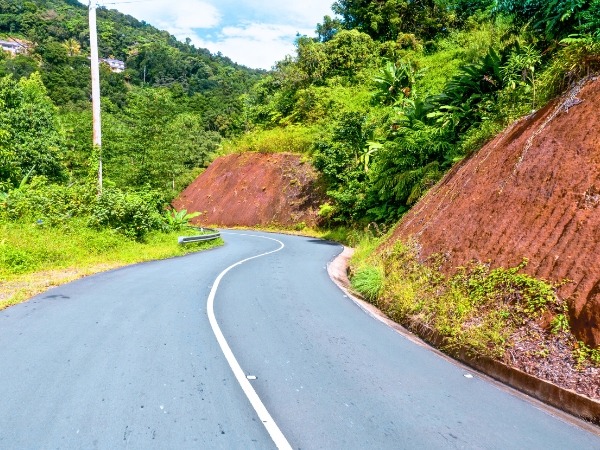
One of the most distinctive and potentially hazardous features of Dominican roads is the presence of deep, concrete, V-shaped drainage ditches known locally as gullies. These are designed to funnel the island’s immense tropical rainfall away from the tarmac to prevent washouts and flooding. However, they are often uncovered and located directly at the edge of the narrow driving lane without any barrier.
If you drift too far to the left while trying to make room for an oncoming bus, your tyre can easily become wedged in a gully, often requiring a professional tow truck or a group of strong locals to extract the vehicle. Always give yourself a small buffer of space between your wheels and the edge of the road, even if it feels like you are closer to the centre than usual. It is better to stop and wait for a large vehicle to pass than to risk sliding into a gully.
Driving in Dominica is a communal experience, and the road is rarely occupied by cars alone. In rural areas, it is extremely common to encounter livestock, such as goats, cows, dogs, and chickens, wandering across the tarmac at their own leisure. Furthermore, pedestrians frequently walk along the shoulder or even in the road where sidewalks are nonexistent.
During the early morning or late afternoon, school children and farmers carrying tools like machetes are a common sight. Always maintain a moderate speed when passing through residential areas, as children or animals may unexpectedly dart into the road. Being a vigilant driver means scanning the edges of the road just as much as the path directly in front of you.
The pace of life in this country is very relaxed, and this island time extends to the roads. Dominicans are generally very helpful and polite drivers. If you show patience and follow the local rhythm, you will find the experience far less stressful. Embrace the journey as part of the sightseeing experience rather than a hurdle to be cleared as quickly as possible.
You may find yourself behind a slow-moving lorry carrying timber or a public minibus stopping frequently and unexpectedly to pick up passengers. Rather than attempting a risky overtake on a blind curve, it is better to wait for a clear straightaway or for the driver ahead to give you a hand signal or a beep to wave you past.
While there are many gas stations in the major hubs of Roseau and Portsmouth, they become increasingly scarce once you head into the central rainforest, the rugged eastern coast, or the northern tip of the island. Additionally, most gas stations in rural areas are not open 24 hours and may close early in the evening or on Sundays.
It is a golden rule of driving in Dominica to never let your fuel gauge drop below a quarter tank. If you see a station and you are at half a tank, it is often worth the five-minute stop to ensure you aren't stranded in a remote mountain pass. If you are planning a full day of exploring the Morne Trois Pitons National Park or the heights of the Kalinago Territory, ensure you fill up before leaving the main towns.
For tourists, driving after dark should be kept to a minimum whenever possible. Most of the mountain roads lack street lighting, and the combination of pitch-black conditions, sharp drops, and a total lack of guardrails can be disorienting even for experienced drivers. Heavy tropical downpours can also occur suddenly at night, reducing visibility to near zero and occasionally causing small landslides or branches to fall onto the road.
Furthermore, pedestrians and animals are much harder to spot and avoid at night. It’s best to aim to finish all your day trips before the sun sets. If your flight arrives late or you have a dinner engagement far from your hotel, drive significantly slower than usual and be extra vigilant for hazards that would be obvious during the daylight hours.

Driving in Dominica can be daunting for tourists at first, but the rewards are unparalleled. The island’s roads connect its vibrant culture and stunning natural wonders, and there is a profound sense of satisfaction in navigating them successfully. By ensuring you have the right vehicle for the terrain, mastering the left-hand drive, knowing local road language, and adapting to the island pace, you transform your standard vacation into an immersive journey.
Whether you are chasing waterfalls in the morning or catching a sunset over the Caribbean Sea in the evening, the independence afforded by a rental car is your greatest asset. Do not let the lack of familiarity hold you back from the adventure of a lifetime. Rent a car on Final Rentals today, embrace the unique rhythm of the Nature Island, and prepare to see Dominica in the most authentic way possible.